Yes, cold pressed coconut oil is a useful everyday oil for hair, skin and medium-heat cooking. It is made without heat, so it keeps its coconut smell and natural compounds. It may help hair strength and dry skin, and it suits Indian cooking at medium heat. But it is high in saturated fat, so eat it in small amounts.
Coconut oil has lived in Indian kitchens for generations. Your grandmother oiled hair with it and cooked with it. Now it comes with new labels and big claims. This blog clears that confusion in plain words.
You will learn what cold pressed coconut oil means. You will see how it differs from virgin and refined oil. You will get its 7 real benefits. You will learn safe cooking limits and daily amounts. You will learn who should avoid it. You will learn how to pick a pure jar.
| Question | Simple Answer |
|---|---|
| What is it? | Oil pressed from coconut meat without heat |
| Best for? | Hair, dry skin and medium-heat cooking |
| Cooking amount? | 1 to 2 teaspoons a day in food |
| Hair use? | Warm oil, apply before wash, leave 30 minutes |
| Skin use? | A pea-sized amount on damp skin after bath |
| Who should avoid it? | Coconut allergy, acne-prone face, heart disease |
| When to see change? | Hair and skin feel better in 2 to 4 weeks |

Cold pressed coconut oil is oil pressed from coconut meat without heat.
Heat can damage the natural compounds in oil. A coconut oil cold press avoids heat, so the oil keeps its smell and taste. Makers press dried flesh or fresh coconut milk. Both count as cold pressed if no heat is used.
Many people ask what is virgin coconut oil. Virgin coconut oil means oil from fresh coconut meat with little processing. Cold pressed is a method of making oil. Virgin is a grade of oil quality. The best jars are often both virgin and cold pressed.
Cold process coconut oil means the same thing. It was made without heat. Read the method line on the label.

Virgin means little processing. Refined means heavy processing. Cold pressed means no heat. Extra virgin is mostly a label word.
Refined coconut oil starts as dried coconut meat called copra. Makers press it, steam it, bleach it and deodorise it. This removes smell, taste and some natural compounds. The result is a neutral oil with a higher smoke point.
Unrefined coconut oil is the same as virgin coconut oil. Both mean little processing and a strong coconut smell. Extra virgin coconut oil is also the same in most cases. For coconut oil, extra virgin has no legal meaning. It is a marketing word that sounds premium.
| Type | Made from | Taste and smell | Smoke point | Best for |
|---|---|---|---|---|
| Virgin (unrefined) | Fresh coconut meat | Strong coconut smell | About 350°F (177°C) | Skin, hair, medium heat |
| Extra virgin | Fresh coconut meat | Strong coconut smell | About 350°F (177°C) | Same as virgin |
| Refined (RBD) | Dried copra | Neutral, no smell | About 400 to 450°F (204 to 232°C) | High-heat cooking |
| Cold pressed virgin | Fresh or dried meat | Coconut smell | About 350°F (177°C) | Skin, hair, medium heat |
Cold pressed is a method, not a grade. A cold pressed virgin oil smokes near 350°F. A refined oil smokes much higher. Always match the oil to the heat of your cooking.
A cold pressed virgin coconut oil gives you gentle processing and fresh coconut goodness.

Cold pressed coconut oil may help hair, skin and everyday cooking. The proof is strongest for hair and skin.
Hair loses protein each time you wash it. This makes hair thin and weak over time. In a 2003 lab study, researchers tested coconut oil, sunflower oil and mineral oil. Coconut oil was the only oil that reduced protein loss in damaged and undamaged hair. Its lauric acid is small and straight, so it enters the hair shaft. Other oils only coat the surface. This is a lab study on hair fibres, not a trial on people. Still, it is the strongest hair evidence for any common oil.

That is why coconut oil for hair is so popular in India.
Dry skin cracks when its barrier is weak. Virgin coconut oil may help seal moisture back in. In a 2004 trial, 34 patients had dry skin. They applied virgin coconut oil or mineral oil twice a day for 2 weeks. Coconut oil worked as well as mineral oil, with a good safety record. In a second trial with 117 children, virgin coconut oil improved skin hydration more than mineral oil. Both trials were small and short.

That is why coconut oil for skin is a daily habit for many people.
In a small trial, adults with eczema applied virgin coconut oil twice a day for 4 weeks. Skin bacteria counts fell more than with olive oil. The skin barrier also improved more with coconut oil. This trial was small and studied people with eczema. It does not prove the same result for healthy skin. But it shows why dermatologists take coconut oil seriously.
The coconut oil smoke point decides how you cook with it. Virgin cold pressed oil smokes near 350°F. That suits tadka, sautéing and baking. It adds a warm coconut flavour to curries. Do not use it for deep frying.
Coconut oil dissolves even waterproof makeup. Warm a pea-sized amount between your palms. Massage it on your face and wipe it off. Wash with a mild face wash after. If your face is acne-prone, patch test first.
Indian homes have used coconut oil for baby massage for years. A gentle massage may help keep baby skin soft. Warm a few drops between your palms first. Avoid the eyes and mouth. Stop if you see redness or rash. Ask your doctor if your baby has eczema.
Oil pulling means swishing oil in your mouth in the morning. In a 2015 study, 60 teens with gum disease used coconut oil pulling daily. After 30 days, plaque and gum scores fell clearly. The teens also brushed as normal. This study was small and studied teens only. Oil pulling cannot replace brushing and flossing. But it may support a fresher mouth as an extra habit.
Yes for medium heat. No for deep frying. And eat only small amounts.
Cold pressed coconut oil is stable at medium heat. Its saturated fat resists damage better than many seed oils. But saturated fat is also its main drawback. One tablespoon has about 12 grams of saturated fat. That is almost a full day of saturated fat for people at heart risk.
A large review covered 16 trials. It found coconut oil raised LDL cholesterol more than olive or canola oil. The American Heart Association advised against regular use in 2017. Most trials were short, so long-term proof is limited. Still, the honest rule is simple. Use coconut oil for flavour and medium-heat cooking. Use olive or groundnut oil for most daily cooking.
Refined coconut oil suits frying because it has no smell.
| Oil | Smoke point | Use for |
|---|---|---|
| Virgin cold pressed | About 350°F (177°C) | Tadka, sauté, baking |
| Refined | About 400 to 450°F (204 to 232°C) | Frying, roasting, searing |
If the oil smokes, lower the flame or switch to refined oil.

Use small amounts. A little goes a long way.
| Use | Amount | How often | Tip |
|---|---|---|---|
| Hair pre-wash | 1 to 2 teaspoons | 1 to 2 times a week | Warm it, apply to lengths, wash after 30 minutes |
| Skin | Pea-sized amount | Once a day after bath | Apply on damp skin |
| Cooking | 1 to 2 teaspoons | Daily in food | Measure it, do not pour freely |
| Oil pulling | 1 tablespoon | Morning before brushing | Swish 10 to 20 minutes, spit it out |
| Baby massage | A few drops | Daily or as needed | Patch test first |
Start with the smallest amount. More oil does not mean faster results.
Trial amounts differ from daily use. The skin trial used oil twice a day for 2 weeks. Daily skin care needs only a pea-sized amount once a day.

Most people can use it on skin and hair. Eating it daily needs more care.
| If you have this | What to do |
|---|---|
| Coconut allergy | Avoid it fully and check labels |
| Acne-prone face | Patch test, use lightly, stop if breakouts grow |
| Heart disease or high cholesterol | Ask your doctor before daily eating |
| Oily scalp or fine hair | Use only on hair ends, not the scalp |
| Eczema flare or broken skin | Ask your doctor first |
A patch test is easy. Apply a drop on your inner arm and wait 24 hours. If your skin stays calm, the oil suits you.

Read the label first. Pure oil has one ingredient and clear words.
| Check | Good sign | Warning sign |
|---|---|---|
| Ingredients | Only coconut oil | Other oils or additives listed |
| Method words | Cold pressed on the label | No method words at all |
| Smell | Mild, fresh coconut smell | Strong, stale or chemical smell |
| Look | Clear when liquid, white when solid | Yellow or cloudy look |
| Pack | Glass jar, sealed lid | Open or damaged pack |
| Certifications | FSSAI and organic marks | No licence or batch details |
| Source | Known brand, batch details | Unknown seller, no batch details |
Pure coconut oil turns solid below about 24°C. This is normal and shows purity. Warm the jar in warm water to melt it.
Nutriorg sells two coconut oils. Both are certified organic.
Nutriorg Certified Organic Virgin Coconut Oil comes in 250 ml and 500 ml packs. Nutriorg Certified Organic Extra Virgin Coconut Oil also comes in 250 ml and 500 ml packs. Both product names say certified organic. Use the 7 checks above on any jar you buy, including these.
For hair, read our castor oil blog. For skin, read our aloe vera juice for skin blog.
Both jars are certified organic and cold pressed. Pick the one that fits your kitchen and your skin.
Certified organic, cold pressed, unrefined. 250 ml and 500 ml packs.
Shop NowCertified organic, cold pressed, multi-purpose for cooking, skin and hair. 250 ml and 500 ml packs.
Shop NowCold pressed coconut oil is a simple, old oil with real uses. It may help your hair and skin, and it cooks well at medium heat. Use small amounts, pick a pure jar with the checks above, and let your own skin and hair tell you if it suits you.
Yes, chyawanprash benefits include immunity, energy and digestion support, especially in winter. It is a thick Ayurvedic jam made mainly from amla. Herbs, ghee and honey are mixed into the jam. It is not a cure for any disease. Take it daily with warm milk, in the pack dose. Any change takes weeks of daily use, not days.
Winter brings colds, coughs and low energy to many homes. Parents look for simple daily habits that keep children strong. Elders want warmth and stamina through cold months. Chyawanprash has been that winter habit in Indian homes for ages.
This post explains the 7 chyawanprash benefits and what studies show. It also covers the dose and the best time to eat it. You will also learn who should avoid it. The last part shows how to pick a good jar.
| Question | Simple Answer |
|---|---|
| What is it? | A thick Ayurvedic jam made mainly from amla, herbs, ghee and honey |
| Main use | Daily support for immunity, energy and digestion, mainly in winter |
| Adult dose | 2 to 3 teaspoons, twice daily with warm milk (Nutriorg pack) |
| Child dose | 1 to 2 teaspoons, twice daily with warm milk (Nutriorg pack) |
| Best time | Morning, and again in the evening |
| When to notice change | After 4 to 8 weeks of daily use |
| Who should avoid it | Sugar patients, pregnant women and people with allergies should ask a doctor first |

Chyawanprash is a thick, dark jam from classical Ayurveda. Its main ingredient is amla, or Indian gooseberry. The chyawanprash amla base gives it most of its vitamin C. Herbs, ghee and honey are mixed with amla pulp into a jam.
In Ayurveda, chyawanprash is called a rasayana. A rasayana is a tonic meant to support strength and healthy ageing. This ayurvedic chyawanprash is not a medicine for one disease. It is a daily food that supports the whole body over time. This whole-body approach is the base of chyawanprash benefits.

The main chyawanprash advantages are slow and steady. They build over weeks, not overnight. Here are the 7 reasons people take it each winter.

Amla is rich in vitamin C, which supports normal immune function. Herbs like guduchi and pippali add to this effect in Ayurvedic use. The advantages of eating chyawanprash daily show up best with regular use. One study in children found fewer illness episodes after 6 months.

Winter tiredness often comes from poor sleep, heavy food and less sun. Chyawanprash gives steady nourishment from amla, herbs and ghee. In the children study, energy and stamina scores improved over 6 months. Adults may notice the same slow lift, but adult proof is thinner.
Chyawanprash contains herbs and spices that support digestion. Nutriorg says it supports digestion and the absorption of nutrients. It may also ease occasional constipation for some people. Take it with warm milk to make it easy on the stomach.
Cold air often brings cough and throat discomfort. Ayurvedic texts use chyawanprash for respiratory wellness. Herbs like vasa and pippali are linked with breathing support in tradition. This is traditional use, not proof against coughs and colds.
Nutriorg says chyawanprash supports memory through its antioxidant activity. Antioxidants help protect cells from daily damage. Students and elders often take it for this reason in winter. Human proof for memory is still limited, so keep hopes modest.
Amla and other herbs give chyawanprash strong antioxidant activity. Antioxidants may help skin look fresh and slow visible ageing. A rasayana is meant to nourish all body tissues over time. Skin change, if any, takes months and needs good food and sleep.
Chyawanprash benefits for female health centre on energy and stamina. Chyawanprash benefits for male health are much the same. Many people ask if chyawanprash is good for health in general. The fair answer is that it may support general vitality. It will not fix one problem on its own.
Chyawanprash benefits rest mostly on traditional use plus small trials. One large study stands out, and it was done in children. Lab tests show strong antioxidant activity, but that is not human proof. Read the study below before you trust big claims.
In a 6-month study, 627 children aged 5 to 12 took part. Each child took half a teaspoon, about 6 g, twice daily. It was followed by a cup of milk each time. The other group took milk only. The chyawanprash group had less than half the illness episodes. The milk-only group had more episodes in comparison. Energy, strength, stamina and quality of life also improved more.
This was an open-label study, so families knew what children took. It covered children only, so adult results may differ. The study used one brand's product from its own research team. One caution: a COVID study tested chyawanprash inside a four-herb mix. Its faster recovery cannot be credited to chyawanprash alone.
| Point | Study in children | Nutriorg pack |
|---|---|---|
| Who | Children aged 5 to 12 | Adults and children |
| Dose | Half a teaspoon, about 6 g, twice daily | Adults 2 to 3 teaspoons, children 1 to 2 teaspoons, twice daily |
| With what | A cup of milk, 100 to 200 ml | Warm milk |
| Time | 6 months | Daily, mainly in winter |
| Note | Measured in grams | Measured in teaspoons, so the two do not match directly |
Do not copy the study dose on your own. The pack dose is the safer choice for daily use. If you want the study amount, ask an Ayurvedic doctor first.

Dose depends on age and on the brand you buy. Nutriorg gives clear doses on its pack. Other brands often advise 1 to 2 teaspoons a day. Follow your pack, or ask an Ayurvedic doctor.
| Who | Daily dose | How to take |
|---|---|---|
| Adults | 2 to 3 teaspoons, twice daily | With warm milk, morning and evening |
| Children | 1 to 2 teaspoons, twice daily | With warm milk, morning and evening |
| If you are new | Start with 1 teaspoon a day | Raise slowly over a week |

Morning is the most common advice for chyawanprash. Night with warm milk suits people who want a calm routine. Milk helps carry the herbs and softens the taste. Water works too, if you avoid dairy.
| Choice | Good for | Note |
|---|---|---|
| Morning, empty stomach | Energy and immunity routine | Most common advice |
| Night, with warm milk | Calm routine and digestion comfort | Good if mornings are rushed |
| With warm milk | Taste and absorption | Best for most people |
| With warm water | A lighter, dairy-free option | Good if you avoid milk |
Winter is the main season for chyawanprash. Many people take it daily from late October to February. In summer, some people take a smaller dose or pause. There is no strict rule, so listen to your body.

Chyawanprash is safe for most healthy adults in the advised dose. But some people need care. Read this table before you start.
| If this is you | Why to be careful |
|---|---|
| Sugar patients | Chyawanprash is sweet and contains honey. It can raise blood sugar. Keep taking your medicine. Ask your doctor first. |
| Pregnant or breastfeeding women | Safety data is thin in pregnancy. Ask your doctor first. |
| Children under 3 | No set dose exists for very small children. Ask a pediatrician first. |
| Allergy to herbs, ghee or honey | Stop use if you get a rash, itching or stomach upset. Ask a doctor. |
| Acidity or excess body heat | Some people feel heat or acidity. Lower the dose or stop, and ask a doctor. |
This is not a diabetes product. Do not use chyawanprash to control blood sugar. Never stop or reduce your medicine on your own. Ask your doctor first, every time.
Shops sell many jars, and quality varies a lot. A good jar is open about what is inside it. Use these checks before you pay.
| Good sign | Warning sign |
|---|---|
| Full herb list on the pack | No ingredient list at all |
| Amla as the first ingredient | Sugar as the first ingredient |
| Honey as the sweetener | Glucose syrup or added colours |
| Thick jam texture, less sweet taste | Very runny or overly sweet |
| Sealed pack with expiry date | Open, damaged or dateless pack |
A cheap jar with no list is a risk. A clear list shows the maker has nothing to hide. Taste matters too: real chyawanprash is thick, spiced and mildly sweet.

Nutriorg Vedic Chyawanprash starts with amla as the first ingredient. Its pack lists 49 herbs and 5 other ingredients. It is made from organic herbs and fruits. Ghee, black sesame oil and honey bind the mix. Nutriorg says it is less sweet than many other chyawanprash products.
The pack dose is clear for adults and children. Adults take 2 to 3 teaspoons, children 1 to 2, twice daily. Take each dose with warm milk. Packs come in 250 g, 500 g and 1 kg sizes. Nutriorg also sells High Altitude Honey and Vedic Chyawanprash as one combo. To learn more about amla, read our amla juice blogs. For immunity herbs, read our giloy blog.
A classical recipe with amla first, made from organic herbs and fruits.

49 herbs and 5 other ingredients with amla, ghee and honey. Less sweet than many other chyawanprash jars.
Shop NowHindi me jaankari chahiye? Ye raha chyawanprash benefits hindi me saransh:
Chyawanprash ke fayde ye hain: immunity ko support, energy aur stamina. Digestion me madad aur saans ki takleef me aaram bhi milta hai. Roz subah garam doodh ke saath lena behtar hai. Sugar ke mareez doctor se poochkar hi lein.
Chyawanprash benefits are best seen as slow, daily support, not quick magic. Take it each winter morning with warm milk, and give it time. If you have diabetes or are pregnant, ask your doctor first. A good jar, taken the right way, warms up your winter routine.
Pumpkin Seed Oil Capsules are taken mainly for three things: thinning hair, prostate comfort in men, and a frequent urge to pass urine. The best human study on hair used 400 mg a day for 24 weeks. Most capsules are 500 mg, taken once or twice a day after meals. Results take 3 to 6 months, not weeks.
Pumpkin seed oil is pressed from the seeds of the pumpkin plant. It is rich in healthy fats, plant sterols and vitamin E. In capsule form, it is easy to take daily, with no oily taste and an exact dose every time.
But many websites list 15 or 20 benefits without telling you what the studies actually used. This blog covers the 6 benefits that have real research behind them, the honest dose, and who should be careful.
| Question | Simple Answer |
|---|---|
| Main uses | Hair thinning, prostate comfort, frequent urination |
| Common dose | 500 mg, once or twice a day, as printed on the label |
| When to take | After meals, with water |
| How long before results | Usually 12 to 24 weeks of daily use |
| Who must ask a doctor first | Men with urine problems, pregnant women, people on BP, diuretic or lithium medicine |
| Common side effects | Rare. Mild stomach upset in a few people |
Pumpkin seed oil is mostly healthy fats. It contains linoleic acid (an omega-6 fat) and oleic acid (an omega-9 fat), along with plant sterols, vitamin E and carotenoids.
Researchers believe the plant sterols and fatty acids are the reason pumpkin seed oil may help hair and the prostate. These compounds may block an enzyme called 5-alpha reductase. This enzyme turns testosterone into DHT, a hormone linked to both hair thinning and prostate growth.

This is the benefit with the strongest study. In a 2014 trial, 76 men with pattern hair loss took either 400 mg of pumpkin seed oil a day or a dummy pill for 24 weeks. Hair count went up by about 40 percent in the pumpkin seed oil group, compared to about 10 percent with the dummy pill.
Two honest points. First, it was one small study and has not been repeated on a large scale. Second, the capsule used in that study also had a few other plant powders. So pumpkin seed oil for hair growth looks promising, but it is not a guaranteed fix.

Women also search for pumpkin seed oil for hair loss. A separate small study in women with pattern hair thinning used pumpkin seed oil on the scalp for three months and saw some improvement. Evidence for capsules in women is still limited. If you are a woman with hair fall, get your iron, thyroid and vitamin D checked first, because these are common causes in India.

As men age, the prostate often grows. This causes weak flow, waking at night to pass urine, and a feeling that the bladder is not empty. This is called BPH.
Pumpkin seed has been used for this for a long time in Europe. In a one-year German study of 1,431 men called GRANU, whole pumpkin seeds (10 g a day) eased urinary symptoms more than a dummy pill. A smaller study using 320 mg of pumpkin seed oil a day also reported improvement in symptom scores.
Overactive bladder means a sudden, strong urge to pass urine, many trips in a day, and waking at night. It affects both men and women. In a 12-week Japanese study of 45 adults, pumpkin seed oil lowered overactive bladder symptom scores, including night-time trips.
Important: that study used 10 g of oil a day. That is far more than one or two capsules. So treat bladder benefits from capsules as a gentle support, not a strong effect.
Pumpkin seed oil is rich in unsaturated fats and plant sterols, which are friendly to the heart. In a small study of women after menopause, pumpkin seed oil raised HDL, the good cholesterol, compared to wheat germ oil. Use it as a support along with diet and exercise, not as a cholesterol medicine.
Pumpkin seed oil carries vitamin E and carotenoids. These antioxidants help protect your cells, including skin and hair cells, from daily damage. This is a general wellness benefit that supports the others.
This is where most articles go wrong. Different benefits were studied at very different doses. Here is the honest picture.
| Benefit | What Was Used | Daily Amount | Duration |
|---|---|---|---|
| Hair growth (men) | Pumpkin seed oil capsules | 400 mg | 24 weeks |
| Prostate (BPH) | Pumpkin seed oil | 320 mg | 12 months |
| Prostate (GRANU) | Whole pumpkin seeds | 10 g seeds | 12 months |
| Overactive bladder | Pumpkin seed oil | 10 g oil | 12 weeks |
What this means for you: a 500 mg capsule once or twice a day is close to the doses used in the hair and BPH oil studies. For bladder support, capsules give much less than the study amount, so expect only a mild effect. Never take more than the label dose to match a study. Ask your doctor instead.


| Point | Capsules (Oral) | Oil on Scalp (Topical) |
|---|---|---|
| Study support | Men, 400 mg a day, 24 weeks | Women, 3 months, small study |
| How it may work | From inside, through the blood | Directly on the scalp |
| Ease | Easy, no mess | Oily, needs washing |
| Best for | Daily routine, men and women | Extra scalp care, 2 to 3 times a week |
Many people do both. Take the capsules daily and massage a few drops of cold pressed pumpkin seed oil into the scalp once or twice a week. Wash it off after one to two hours.
| Time | What to Expect |
|---|---|
| Weeks 1 to 4 | No visible change. This is normal. |
| Weeks 6 to 12 | Some people notice less hair fall or fewer night-time bathroom trips. |
| Weeks 12 to 24 | The period when the hair study saw its result. Compare monthly photos. |
| After 6 months | If nothing has changed, talk to a doctor about other options. |
Pumpkin seed oil capsules are well tolerated by most adults. Side effects are rare and usually mild, like an upset stomach or loose motions. Taking the capsule after food usually helps.
Pumpkin seed oil is a food supplement. It is not a medicine for hair loss, BPH or bladder problems. If your symptoms are strong or getting worse, please see a doctor.

| Look For | Avoid |
|---|---|
| Clear mg per capsule on the label | No dose mentioned |
| Cold pressed or organic pumpkin seed oil | Blends where pumpkin oil is a small part |
| Softgel in a sealed, dark bottle | Loose or damaged packing |
| FSSAI licence and batch details | Missing licence or expiry date |
| Simple ingredient list | Many fillers and colours |
Store the bottle in a cool, dry place away from sunlight. Healthy oils can go rancid in heat.
A simple daily softgel for hair, prostate and bladder comfort.

500 mg pumpkin seed oil in each softgel, made from 100% organic pumpkins. 60 softgels in a bottle.
Shop NowPumpkin seed oil capsules are a simple, well-tolerated supplement with real, if early, research behind them for hair, prostate and bladder comfort. Take the right dose after meals, give it at least three to six months, and keep your expectations honest. And for any urine problem or sudden hair loss, see a doctor first. Used this way, pumpkin seed oil can be a useful part of your daily routine.
Apple cider vinegar may give a small, helpful nudge to blood sugar control in people with type 2 diabetes, when taken diluted in water before meals or at bedtime. Studies show modest improvements, not dramatic ones. It is not a cure, it cannot replace your medicine, and some people should avoid it. Always ask your doctor first.
You have probably seen the reels. A spoon of apple cider vinegar before food, and your sugar spike disappears. Some of that is true, and a lot of it is exaggerated.
This guide tells you what the research says in simple words, how much to take, when to take it, who should stay away, and the mistakes that can turn a healthy habit into a problem.
| Question | Simple Answer |
|---|---|
| Does it help? | It may help a little with fasting sugar and after-meal spikes in type 2 diabetes. |
| How much? | Start with 1 teaspoon (5 ml). Most studies used 1 to 2 tablespoons (15 to 30 ml) a day. |
| How to take? | Always mixed in a full glass of water. Never neat. |
| When? | 15 to 20 minutes before a carb-heavy meal, or at bedtime. |
| Who should avoid it? | People with gastroparesis, low potassium, ulcers, or frequent low sugar episodes. |
| Can it replace medicine? | No. Never stop or reduce your medicine on your own. |

Apple cider vinegar has been studied for blood sugar for over 20 years. Here is a simple summary of the most useful research.
A small study from Arizona State University found that 2 tablespoons of apple cider vinegar with a small snack at bedtime lowered waking blood sugar in people with type 2 diabetes. The effect was about 4 to 6 percent, and it was strongest in people whose morning sugar was above 130 mg/dL.
Several studies found that vinegar taken before a high-carb meal can reduce the sugar rise after that meal. Researchers think the acetic acid in vinegar slows how fast the stomach empties and helps muscles take up sugar.
A 2025 review that combined seven controlled trials in people with type 2 diabetes found that apple cider vinegar was linked with lower fasting blood sugar and lower HbA1c. The effect looked stronger at doses above 10 ml a day. The researchers also noted that the studies were small and results varied.
So the honest picture is this. Apple cider vinegar for diabetes may offer a small benefit as part of your routine. It is not strong enough to replace medicine, diet or exercise.
These effects are small. Think of apple cider vinegar as a helper for your plate, not a tool to fix high sugar on its own.

| Stage | Amount | How |
|---|---|---|
| Week 1 | 1 teaspoon (5 ml) once a day | In a full glass of water, before your biggest meal |
| Week 2 onward | 1 tablespoon (15 ml) once a day | Same way, if your stomach is fine |
| Only if doctor agrees | Up to 2 tablespoons (30 ml) a day | Split into two doses, never more |
Mix 1 tablespoon of apple cider vinegar in a glass of water with a pinch of jeera powder and a little black salt. Sip it before lunch or dinner.
Toss cucumber, onion and tomato with 1 teaspoon of apple cider vinegar, salt and pepper. Eating this salad first, before rice or roti, adds fibre and vinegar together.
Add a few drops to mint chutney or onion raita instead of lemon. It gives a tangy taste with the same benefit.
Skip honey in your apple cider vinegar drink. Honey is sugar, and many reels add it without telling you.

This is the most dangerous mistake. Even if your readings look better, only your doctor can change your medicine. Apple cider vinegar is a support, not a treatment.
Undiluted vinegar can burn the throat and damage tooth enamel. Always mix it in a full glass of water.
More vinegar does not mean lower sugar. High doses can cause stomach pain, nausea and low potassium. Stay at 1 to 2 tablespoons a day at most.
Many apple cider vinegar gummies and ready drinks have added sugar. For a sugar patient, this defeats the purpose. Use plain, unsweetened apple cider vinegar.
If you take insulin or certain tablets, adding vinegar may push sugar lower than usual. Check more often in the first weeks and share the readings with your doctor.

| If You Have This | Why to Be Careful |
|---|---|
| Diabetic gastroparesis (slow stomach) | Vinegar may slow stomach emptying further and make sugar harder to control |
| Low potassium, or on diuretics or digoxin | Large amounts of vinegar may lower potassium |
| On insulin or sulfonylurea tablets | Sugar may drop too low. Doctor must guide the dose |
| Acidity, reflux or ulcers | Vinegar is acidic and may worsen symptoms |
| Kidney disease | Ask your doctor before any regular acidic drink |
| Pregnancy | Ask your doctor first |
If you feel shaky, sweaty, dizzy or confused after starting, check your sugar right away. If it is low, take something sweet and check again after 15 minutes. Then call your doctor.
Some of the early vinegar studies were done in people with insulin resistance, which is common in prediabetes. Vinegar before a carb-heavy meal helped their after-meal sugar more than it helped people with type 2 diabetes. If your doctor has told you your sugar is borderline, a diluted spoon before meals, along with walking and less refined carbs, is a reasonable habit to discuss.
People with type 1 diabetes depend fully on insulin. Vinegar may change how fast food is absorbed, which can make insulin timing harder. In people with type 1 diabetes who also have slow stomach emptying, a small study found vinegar slowed the stomach further. Do not try it without your diabetes doctor's guidance.
Many Indian homes already use methi or lemon water for sugar. Here is how they compare.
| Point | Apple Cider Vinegar | Methi Water | Lemon Water |
|---|---|---|---|
| Main active part | Acetic acid | Soluble fibre | Citric acid, Vitamin C |
| Research for sugar | Several small trials and reviews | Several small trials | Very limited |
| Best time | Before meals or bedtime | Morning, empty stomach | Any time |
| Main caution | Acidic, dilute well | May cause gas | Acidic for teeth |
You do not need all three. Pick one habit your stomach suits and your doctor approves, and stay regular.

Choose plain apple cider vinegar with no added sugar. Raw, unfiltered vinegar with the cloudy mother is the type most people prefer. The acetic acid content matters more than fancy claims.
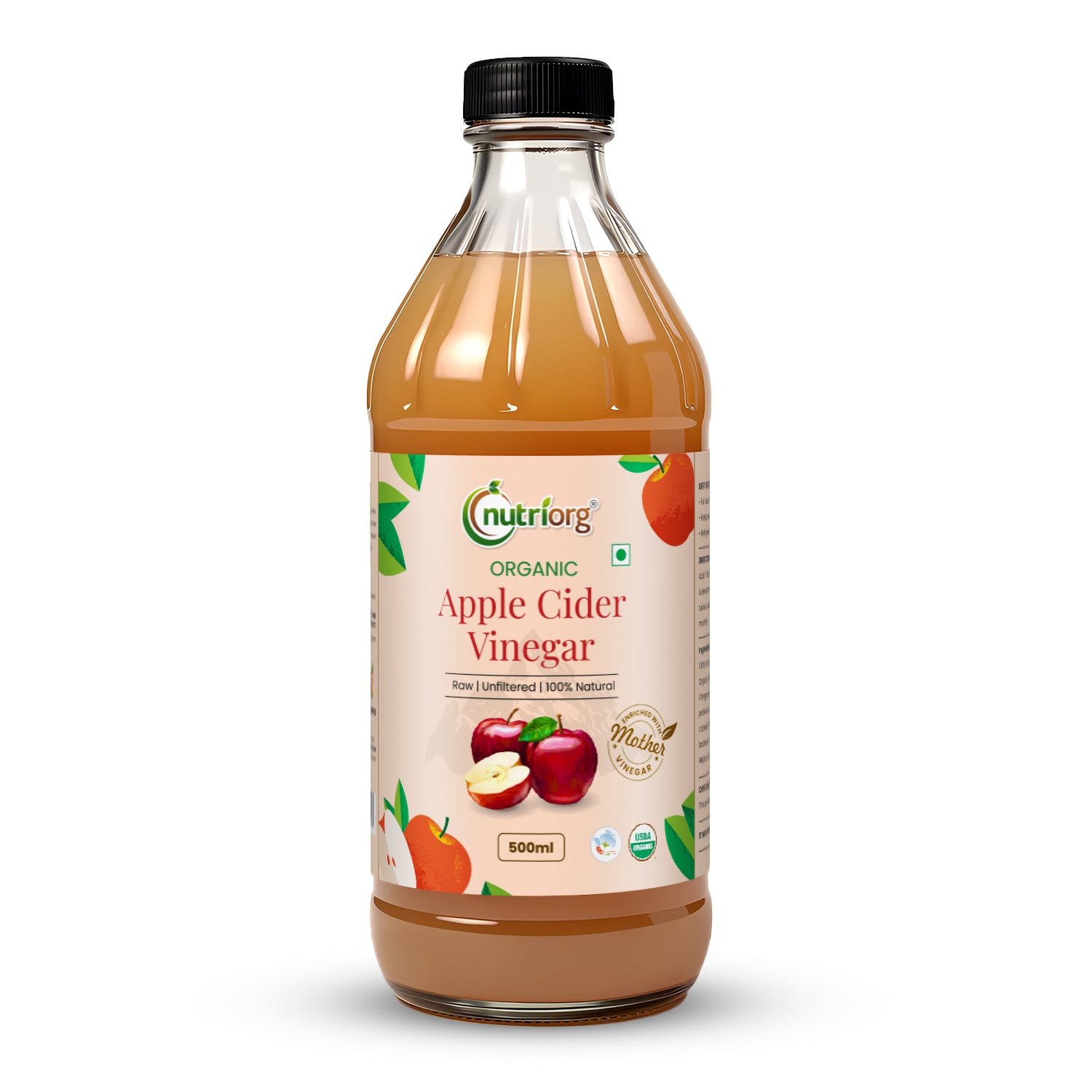
Nutriorg Certified Organic Apple Cider Vinegar is raw and unfiltered, with the mother, and no added sugar. If you also want an Ayurvedic herbal support, Nutriorg Diabetic Care Juice combines 18 herbs including karela and jamun. Both are supports, not cures, and should be used with your doctor's advice.
Raw, unfiltered, with the mother — no added sugar. The clean choice for sugar patients.
Apple cider vinegar is a simple kitchen habit that may give your blood sugar a small helping hand. Dilute it, measure it, take it before meals, and watch your readings. Above all, keep taking your medicine and stay in touch with your doctor. Used this way, apple cider vinegar can be a safe, small part of your diabetes routine.
Spirulina is a blue-green algae that is very rich in protein, iron and antioxidants. These nutrients may help people who feel tired because of low iron or a poor diet. One small study found it helped trained men exercise longer, but other studies are mixed. Start with 1 to 2 grams a day and build up to 3 to 5 grams.
Spirulina is sold as a superfood almost everywhere now. Gym trainers recommend it. Wellness pages call it a miracle green powder. But what can it actually do for your energy?
This guide explains the real spirulina benefits for energy and stamina, what the studies show, how much protein it gives, and how to take it without the fishy taste.
| Question | Simple Answer |
|---|---|
| What is it? | A dried blue-green algae, sold as powder or tablets |
| Main nutrients | Protein, iron, B vitamins, beta-carotene, antioxidants |
| Daily amount | Start 1 to 2 g. Most people take 3 to 5 g a day |
| Best time | Morning, with breakfast or before a workout |
| When to notice change | Usually after 3 to 4 weeks of daily use |
| Who should avoid it | People with PKU, autoimmune disease, pregnancy without doctor advice |

Spirulina is a tiny blue-green algae that grows in fresh and salty water. It is dried and sold as a dark green powder or tablets. It has been eaten for centuries and is one of the most nutrient-dense foods by weight.
Its deep colour comes from chlorophyll and a blue pigment called phycocyanin. Phycocyanin is a strong antioxidant and is one reason spirulina is studied for fatigue and recovery.

This is one of the most searched questions. Dried spirulina is about 57 to 60 percent protein. Here is the approximate nutrition per 100 g of dried spirulina powder.
| Nutrient | Per 100 g (approx.) | Per 5 g serving |
|---|---|---|
| Protein | 57 g | about 3 g |
| Iron | 28 mg | about 1.4 mg |
| Energy | 290 kcal | about 15 kcal |
| Fat | 8 g | less than 0.5 g |
| Beta-carotene (vitamin A source) | High | Moderate |
Important: 100 g is a lot of spirulina. Nobody eats that much in a day. A normal 5 g serving gives about 3 g of protein. That is helpful, but it is not a replacement for dal, paneer, eggs or a protein shake.

Low iron is one of the most common reasons for tiredness in India, especially in women. Spirulina is rich in iron. In a 14-day study, people taking 6 g of spirulina a day saw their hemoglobin rise by about 3.4 percent. If your tiredness comes from low iron, this may help over time.
In a small study, 9 trained men took 6 g of spirulina a day for 4 weeks. They could run longer before getting tired, and their body burned more fat during exercise.
But a later study on 17 cyclists, using the same dose for 14 days, found no clear change in stamina, even though hemoglobin went up. So the honest answer is: spirulina may help some people, but it is not a guaranteed performance booster.
Exercise and daily stress create damage inside cells. Spirulina's antioxidants, especially phycocyanin, may help the body handle this. In the running study, spirulina also raised levels of glutathione, one of the body's own antioxidants.
Skipped meals, fast food and late nights leave many people short on nutrients. A spoon of spirulina adds protein, iron, B vitamins and beta-carotene in one go. Better nutrition often means steadier energy through the day.
For vegetarians who struggle to eat enough protein, spirulina is a useful small addition. It contains all essential amino acids. It works best alongside dal, curd, paneer and other protein foods.

Men usually take spirulina for gym stamina, recovery and general energy. The most useful benefits are its protein, antioxidants for recovery, and possible support for endurance. Take it in the morning or 30 to 60 minutes before a workout.
For women, the iron in spirulina is the biggest plus, because low iron and anemia are very common among Indian women. It also gives beta-carotene and antioxidants for skin. Women who feel tired all the time should first check hemoglobin, ferritin, thyroid and vitamin D with a doctor.
Many labels say spirulina is rich in B12. Most of this is a form called pseudo-B12, which the human body cannot use well. So vegetarians and vegans should not depend on spirulina for B12. Take a proper B12 supplement if your doctor advises it.

| Week | Daily Amount | Tip |
|---|---|---|
| Week 1 | 1 to 2 g (about half a teaspoon) | Lets your stomach adjust |
| Week 2 onward | 3 to 5 g (1 to 1.5 teaspoons) | A common daily amount |
| Active people | Up to 6 g, if your doctor agrees | This was the amount used in studies |
Spirulina has a strong, sea-like taste. These simple tricks make it easy to take.
All three are green powders, but they are not the same. Here is a simple comparison.
| Point | Spirulina | Moringa | Wheatgrass |
|---|---|---|---|
| What it is | Blue-green algae | Dried drumstick leaves | Young wheat grass |
| Protein | Very high (about 57%) | Moderate (about 25%) | Low |
| Iron | High | Good | Moderate |
| Best for | Protein, stamina, iron | Iron, calcium, women's health | Greens, fibre, detox routine |
| Taste | Strong, sea-like | Earthy, mild | Grassy |
If your main need is protein and stamina, spirulina is the strongest choice. If you want an iron and calcium boost with a milder taste, moringa works well. Wheatgrass suits people who want a daily green habit with fibre. Some people rotate between them.
| Time | What Many People Notice |
|---|---|
| Week 1 | Mild stomach changes as the body adjusts. No energy change yet. |
| Weeks 2 to 4 | Some people feel less tired, especially if their iron was low. |
| After 4 to 8 weeks | Better stamina in workouts for some. Check hemoglobin if you were anemic. |
| No change after 2 months | Your tiredness may have another cause. See a doctor. |

Spirulina is safe for most healthy adults when it comes from a clean source. Mild side effects can include gas, nausea, headache or a green colour in the stool, especially at the start.
| If You Have This | Why to Be Careful |
|---|---|
| PKU (phenylketonuria) | Spirulina contains phenylalanine. Avoid it |
| Autoimmune disease (lupus, RA, MS) | It may stimulate the immune system. Ask your doctor |
| On blood thinners or immune-suppressing medicine | Ask your doctor first |
| Pregnancy or breastfeeding | Not enough safety data. Ask your doctor |
| Seafood or algae allergy | Avoid or test carefully with a doctor |
The biggest real risk is contamination. Poorly grown spirulina can contain heavy metals or toxins from other algae. Buy only from a trusted brand that shares lab testing and an FSSAI licence.
| Good Sign | Warning Sign |
|---|---|
| Bright dark green or blue-green colour | Dull, brownish or faded colour |
| Lab tested for heavy metals | No testing information |
| 100 percent spirulina in ingredients | Fillers, sugar or flavours |
| FSSAI licence and batch details | Missing licence or dates |
| Airtight, moisture-proof pack | Loose or damaged packing |
Nutriorg Spirulina Powder is pure spirulina with nothing else added. Use the checks above on any pack you buy. Store it in a cool, dry place and close the lid tightly.
Pure spirulina with nothing else added — for protein, iron and everyday energy.
Pure spirulina with nothing else added. Rich in protein, iron and antioxidants.
Shop NowTwo packs of pure spirulina powder. Best value for daily energy support.
Shop Pack of 2Spirulina is a small spoon of serious nutrition. It will not replace sleep, real food or a check-up, but it can fill gaps that leave you tired, especially low iron and low protein. Start small, take it in the morning, pick a clean tested brand, and give it a month. Your energy may thank you for it.

Quick Answer
Wheatgrass powder is young wheat leaves, dried and ground fine. Because it keeps the fibre, it may support digestion, and it gives chlorophyll, vitamins and iron in a form that lasts for months. Start with half a teaspoon in water or a smoothie each morning, then go up to one teaspoon.
Fresh wheatgrass juice sounds great. But growing trays of grass, juicing them and drinking within minutes is hard for most Indian homes. This is why so many people now buy wheatgrass powder instead.
But then new doubts come up. Is powder as good as juice? How much should I take? Why does it taste like a lawn? Can I take it at night?
This guide answers all of it in simple words. You will learn the real benefits of wheatgrass powder, the honest difference between powder and juice, and 5 easy ways to use it every day.
Wheatgrass is the young grass of the wheat plant. It is cut early, before the plant makes grain. The leaves are then dried at low heat and ground into a fine green powder.
Whole wheatgrass powder uses the entire leaf. So along with chlorophyll, vitamins and minerals, you also get the natural fibre of the grass.

There are actually three forms, and most people mix them up.
| Point | Fresh Juice | Whole Powder | Juice Powder |
|---|---|---|---|
| Made from | Freshly pressed grass | Whole leaf, dried and ground | Juice, dried into powder |
| Fibre | Very little | Yes, keeps the fibre | Very little |
| Strength | High | Moderate | Most concentrated |
| Serving size | One small shot | Around 1 teaspoon | Smaller, as per label |
| Shelf life | Minutes | Months if kept dry | Months if kept dry |
| Taste | Strong, sweet grass | Grassy, a bit gritty | Smoother, milder |
Here is the key point. Whole powder keeps the fibre. Juice powder removes the fibre, so its nutrients are packed tighter and the serving size is smaller. A Dr. Berg guide notes that an 8 g serving of whole wheatgrass powder can carry up to 4 g of fibre, while juice powders usually need only about 1.5 to 5 g per serving.
Neither is bad. They just suit different needs.
| If You Want This | Pick This |
|---|---|
| Better digestion and more fibre | Whole wheatgrass powder |
| Maximum strength in a tiny dose | Wheatgrass juice powder |
| Freshest taste, no processing | Fresh juice, if you can grow and press it daily |
| Easy daily habit, long shelf life | Whole wheatgrass powder |
| Ready to drink, no mixing | Bottled wheatgrass juice |

Wheatgrass is not a medicine. But as part of a good diet, it may support your body in these ways.
Most Indians eat less fibre than they need. Whole wheatgrass powder adds some natural fibre to your day, which may help keep digestion regular.
The bright green colour comes from chlorophyll. Wheatgrass also carries plant antioxidants, which help protect cells from daily wear and tear.
Wheatgrass has iron, magnesium and other minerals. It is not a replacement for iron tablets, but it adds to a healthy plate.
Many people skip green vegetables on busy days. One spoon of wheatgrass powder is a simple way to add some greens without cooking.
Good digestion, enough water and antioxidant-rich food all show on your skin. Wheatgrass powder can be one small part of that routine.
Your liver and kidneys do the real cleaning. A green drink with water in the morning supports good habits, like staying hydrated and eating fresh food.

Mix half to one teaspoon in a glass of room-temperature water. Add half a lemon. Stir or shake well. Lemon cuts the grassy taste.
Blend with banana, a few mango pieces or pineapple. The sweet fruit hides the grassy taste almost fully. This is the easiest way for beginners.
Add half a teaspoon to a glass of chaas with roasted jeera and a pinch of salt. This is a very Indian and very tasty way to take it.
Mix into nimbu pani or tender coconut water on hot days. It turns into a cooling green drink.
Sprinkle a little on dal, soup or poha after it is cooked and slightly cooled. Do not cook the powder, because high heat can reduce some of its vitamins.
Tip to Avoid Lumps
Put the powder in a bottle first, add a little water, shake well, then add the rest of the water. It mixes smoothly and does not stick to the glass.

| Week | Daily Amount | Why |
|---|---|---|
| Week 1 | Half a teaspoon | Lets your stomach get used to the fibre |
| Week 2 onward | One teaspoon | A common daily amount for adults |
| Always | Follow the pack label | Strength differs between brands |
The best time is morning, on an empty stomach or with breakfast. Drink a full glass of water with it, because fibre needs water to work well.

This is the most common complaint online. Wheatgrass tastes like fresh grass because, well, it is grass. The taste is strong, but you can soften it.
Gluten is found in the wheat grain, not in the young grass. So wheatgrass cut before it makes grain is usually free of gluten. But cross-contact can happen during farming or packing.
If you have celiac disease or a strong gluten allergy, look for a pack that says tested gluten free, and ask your doctor first.


| Good Sign | Warning Sign |
|---|---|
| Bright, fresh green colour | Dull, yellow or brown colour |
| Certified organic | No certification mentioned |
| Only wheatgrass in the ingredients | Fillers like maltodextrin or sugar |
| Fresh grassy smell | Stale or musty smell |
| Airtight, moisture-proof pack | Loose or damaged packing |
Store it in a cool, dry place and close the lid tightly every time. Moisture makes the powder clump and go stale.
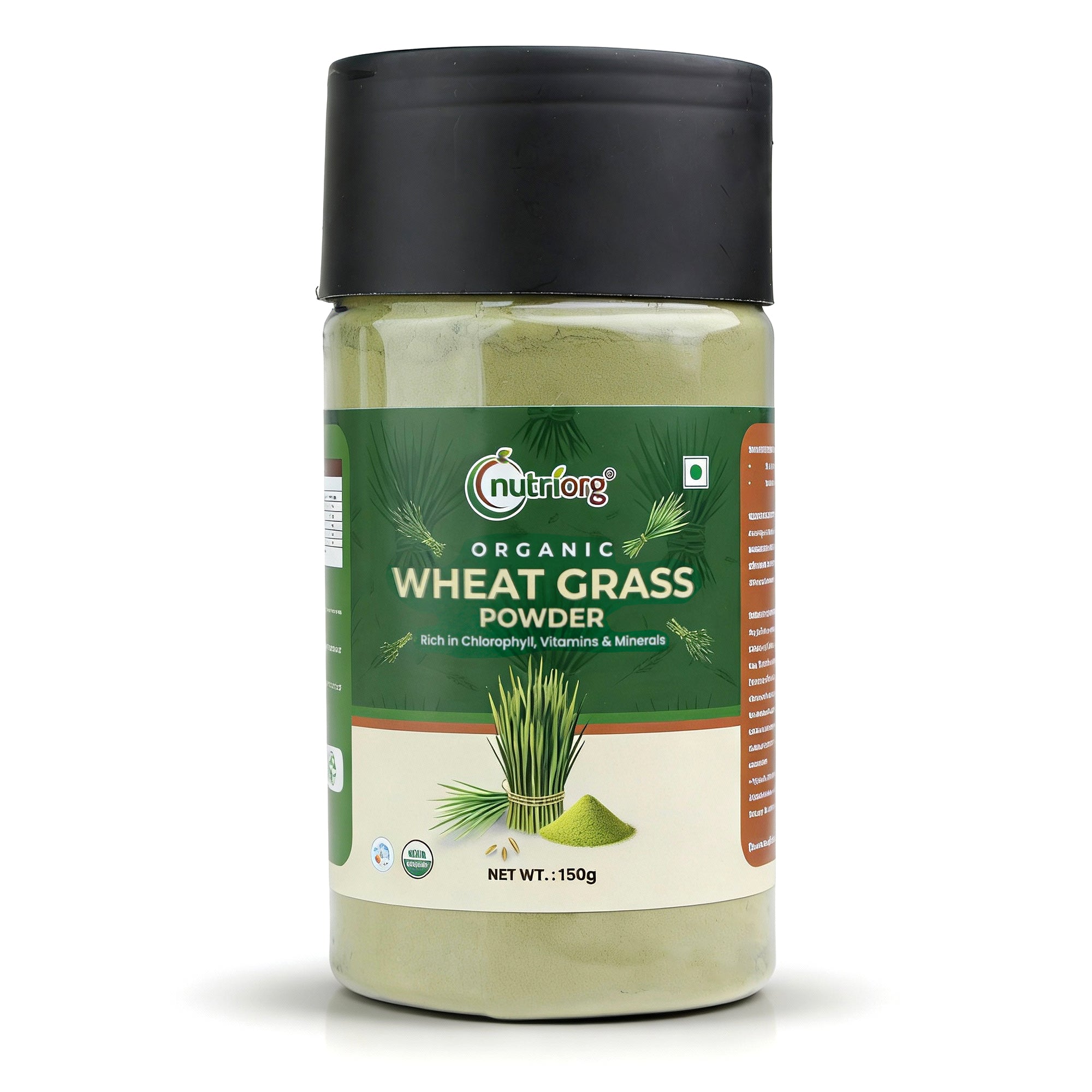
If you want an easy daily green habit, Nutriorg Certified Organic Wheatgrass Powder is made from young organic wheatgrass, with nothing else added. Use the checks above on the pack yourself. And if you prefer a ready drink, Nutriorg Wheat Grass Juice is also available.
Made from young organic wheatgrass — nothing else added. Bright green, fresh and pure.
Wheatgrass powder is one of the simplest ways to add greens to a busy Indian day. Pick whole powder if you want fibre, start small, mix it cold, and make it a morning habit. It is not a magic cure, but with good food and water, the benefits of wheatgrass powder can add up over time.

Yes, for most healthy adults, drinking amla juice on an empty stomach in the morning is a good habit. Mix 15 to 30 ml in a glass of room-temperature water and drink it 20 to 30 minutes before breakfast. If you get acidity easily, take it after a light snack instead.
Amla is one of the richest natural sources of Vitamin C, far richer than an orange. On an empty stomach, there is no food competing with it, so your morning glass starts the day with a clean dose of Vitamin C, antioxidants and fibre.
But the empty stomach rule does not suit everyone. This guide covers the 7 real benefits, the right dose, a simple morning routine, and the people who should change the timing.

| Question | Simple Answer |
|---|---|
| How much? | Start with 15 ml. Go up to 30 ml a day, or as printed on the label. |
| How to mix? | In a glass of room-temperature water. Not hot water. |
| When? | 20 to 30 minutes before breakfast. |
| Tea or coffee? | Wait about 45 to 60 minutes after amla juice. |
| Who should change timing? | People with acidity, ulcers or a sensitive stomach. |
| When will I notice a change? | Most people notice small changes in 3 to 4 weeks of daily use. |

In the morning, your stomach is empty and your body is ready to absorb what comes in. Amla juice taken at this time does not have to compete with heavy food, milk or tea.
There is also a habit reason. A small glass before breakfast is easy to remember. People who drink amla juice at a fixed time each morning are far more regular than people who drink it whenever they remember.

Vitamin C supports your body's natural defence. A morning glass of amla juice gives a good amount of it in a natural form. This may help your body stay ready for seasonal coughs and colds.
Vitamin C helps the body absorb iron from plant foods like spinach, chana and poha. If your breakfast is plant based, a glass of amla juice before it may help you get more from that iron. This is useful for many Indian women who run low on iron.
Amla has fibre and natural acids. Many people find that a morning glass helps their digestion feel lighter and their bowel movements more regular.

Your body needs Vitamin C to make collagen, the protein that keeps skin firm. Daily amla juice is a simple way to support your skin from inside, along with water, sleep and sunscreen.
Amla has been used in Indian hair care for generations. Drinking it gives your hair roots antioxidants and Vitamin C from inside. Results on hair take time, usually a few months.
Amla juice is very low in calories. A glass before breakfast may help you feel a little fuller and replace a sugary morning drink. It is a helper, not a fat burner. Food and activity still matter most.
This is the benefit people forget. Starting the day with amla juice and water instead of only chai often leads to better choices through the day. Small habits add up.
| Time | What to Do | Why |
|---|---|---|
| On waking | Drink a glass of plain water | Rehydrates you after the night |
| 10 minutes later | 15 to 30 ml amla juice in a glass of water | Empty stomach, nothing to compete |
| Next 20 to 30 minutes | Walk, stretch or get ready | Gives the juice time to settle |
| Breakfast | A normal, balanced breakfast | Pair with iron-rich foods if possible |
| 45 to 60 minutes after juice | Tea or coffee, if you drink it | Tea right away may reduce iron absorption |

Amla juice is safe for most adults. But for some people, the empty stomach timing causes trouble. If you are in this list, take it after a light snack or with breakfast instead.
| If You Have This | Better Way |
|---|---|
| Acidity or acid reflux | Take it after a few soaked almonds or a light snack |
| Stomach ulcer or gastritis | Ask your doctor before taking it at all |
| Very sensitive teeth | Dilute more and use a straw |
| Diabetes on medicine | Ask your doctor and check sugar regularly |
| Blood thinner medicine | Ask your doctor first |
| Pregnancy or breastfeeding | Ask your doctor about the right amount |
Here is a realistic picture. Results differ for every person, and they depend on your diet and sleep too.
| Time | What Many People Notice |
|---|---|
| Week 1 | Feeling fresh in the morning. Some notice better digestion. |
| Week 2 to 4 | More regular bowel movements. Fewer cravings for a sweet morning drink. |
| Month 2 to 3 | Skin may look fresher. Hair fall may feel less, along with good diet. |
| Long term | A steady habit that supports overall wellness. |

Morning is better for most people. Your stomach is empty, the Vitamin C gets a clean start, and it is easy to make it a daily habit.
Night is not wrong, but it is not ideal. Amla is sour, and some people feel acidity when they lie down soon after drinking something sour. If morning does not work for you, take it in the evening at least 2 hours before bed.
| Point | Morning (Empty Stomach) | Night |
|---|---|---|
| Absorption | Good, nothing to compete | Food from dinner may compete |
| Acidity risk | Low for most, higher for sensitive stomachs | Higher if you lie down soon after |
| Habit | Easy to remember daily | Easy to forget |
| Best for | Most people | People who cannot take it in the morning |
Mix 15 ml amla juice and 15 ml aloe vera juice in a glass of water. A gentle morning drink that many people find good for digestion.
Add 15 to 20 ml amla juice and a little fresh ginger juice to a glass of room-temperature water. Squeeze in some lemon. Fresh and slightly spicy.
Mix amla juice in water with a pinch of black salt and roasted jeera powder. It tastes like a light, healthy jaljeera, without the sugar.
Skip honey and sugar if you have diabetes or are watching weight. The plain version works just as well.

Fresh amla juice is great, but amla is seasonal and making juice every morning takes time. Bottled juice is practical for daily use, as long as it is pure.
Check that amla is the main ingredient, that there is no added sugar, and that the label shows a clear dose. Nutriorg Amla Juice is made from Indian amla with no added sugar, so you can measure, mix and drink it in under a minute.
Pure, cold pressed — no added sugar, nothing fake. Easy to measure and mix every morning.
Pure, cold-pressed amla juice. Rich in Vitamin C and antioxidants. No added sugar.
Shop NowTwo full litres of pure amla juice. Best value for your daily morning habit.
Shop Pack of 2Amla juice on an empty stomach is one of the easiest healthy habits you can start tomorrow morning. Keep it diluted, keep it measured, wait a little before your chai, and change the timing if your stomach complains. Done this way, your morning glass of amla juice becomes a small daily step towards better health.

Quick Answer
Original sea buckthorn juice is deep orange, cloudy and very sour. Its pulp settles at the bottom, so you must shake it. On the label, sea buckthorn comes first, with no added sugar and no other fruit juice. Real berries mostly come from Ladakh and Himachal. Thin, sweet, see-through juice is usually diluted.
Sea buckthorn juice is now sold everywhere. Online stores, chemist shops, even local fairs. Prices go from very cheap to quite costly. So the big question people ask is simple. Which one is real?
This worry is fair. Sea buckthorn is a hard crop to grow and pick. That makes it costly. And costly products are easy to dilute with water, sugar and cheaper juices. Many buyers never find out.
In this guide, you will learn 7 simple checks to spot original sea buckthorn juice at home. No lab needed. Just the label, a white cup and your tongue.

Himalayan sea buckthorn juice is made from small orange berries of the Hippophae plant. In India, this shrub grows wild in cold, high mountain areas.
Ladakh is the main source. A food processing report by NIFTEM says Ladakh holds over 70 percent of India's natural sea buckthorn area. Himachal Pradesh, Uttarakhand, Sikkim and Arunachal also have some.
Why does origin matter? Berries from these cold, high areas grow slowly in tough weather. Buyers trust them more. So a clear source like Leh or Spiti on the label is a good sign. A label with no source at all tells you nothing.

Sea buckthorn is not easy to harvest. The shrubs have sharp thorns. The berries are tiny. The picking season is short. And the areas are far away and cold.
All this makes pure pulp costly. So some sellers mix in water, sugar, apple juice or colour to cut costs. The bottle still looks orange. The front label still says sea buckthorn. But what is inside is very different.
The good news is that dilution leaves clues. You just need to know where to look.

Ingredients are listed from most to least. So the first item is what you get the most of. In pure sea buckthorn juice, sea buckthorn pulp or juice should come first.
If water, sugar or another fruit juice comes first, the product is mostly that, not sea buckthorn. This one check catches most fakes.
This is a smart trick many people miss. Products with low fruit content are often sold as a drink, beverage or nectar, not as juice. Look at the small line under the brand name. If it does not say juice, read the ingredients very carefully.

Real sea buckthorn is very sour. So brands that add a lot of sugar are hiding the real taste, and often hiding dilution too. Check for sugar, invert syrup, honey, fructose or artificial sweeteners in the list.
Also note the difference. No added sugar means nothing was added. It does not mean zero sugar, because the berry has a little natural sugar.

Pour a little juice into a white cup. Real juice is a deep, bright orange and cloudy. You cannot see through it.
If the juice is pale yellow, watery or clear like a soft drink, it is likely thinned with water or filtered heavily.

Leave the bottle still for a few hours. In real pulp juice, the thick part settles at the bottom and the top looks lighter. That is why the label says shake well before use.
A juice that looks exactly the same from top to bottom, with nothing to shake, may have very little real pulp.
Many buyers see a thin orange ring on the bottle neck and think the juice has gone bad. In fact, this is often a good sign. The NIFTEM report explains that sea buckthorn pulp has natural oil, and if it stays in the juice, it can form a layer on the surface.
This oil carries the famous Omega-7. So a light oily ring is normal for pure sea buckthorn juice. A bad smell or fizzing, however, means the juice has spoiled.

Take a small sip without water. Original sea buckthorn juice is sharp, tangy and very sour, with a slight bitter end. It is not pleasant alone. That is why people mix it with water.
If it tastes like sweet orange squash, it is not pure.
| What to Check | Original Juice | Diluted or Fake Juice |
|---|---|---|
| First ingredient | Sea buckthorn pulp or juice | Water, sugar or another juice |
| Product name | Sold as juice | Sold as drink, beverage or nectar |
| Colour | Deep orange, cloudy | Pale, thin, see-through |
| Settling | Pulp settles, needs a shake | Looks the same top to bottom |
| Oil ring | Thin orange ring is normal | Usually none |
| Taste | Very sour and tangy | Sweet, like squash |
| Source on label | Clear, like Leh or Himachal | Not mentioned |
| Price | Higher, because pulp is costly | Very cheap for a big bottle |
You will see three main types in the market. Here is how they differ.
| Type | What It Is | Good to Know |
|---|---|---|
| Pulp juice | Crushed berries with pulp and oil | Most complete, thick, needs shaking |
| Concentrate | Water removed, very strong | Use a very small amount, mix well |
| Clear juice | Pulp and oil filtered out | Easier to drink, less Omega-7 |
For most people, pulp juice gives the best value because the oil and pulp stay in. If you like a smooth drink, clear juice is fine, but you lose some of the berry oil.
Many good brands use a small amount of a food-safe preservative. This keeps the bottle safe for weeks after you open it. A preservative alone does not make a juice fake.
What matters is honesty. The preservative should be listed clearly, and sea buckthorn should still be the main ingredient. Always keep the bottle in the fridge after opening and use it within the time printed on the label.


Start with 15 ml mixed in a glass of water. After a week, you can go up to 30 ml a day. Shake the bottle well every time. Drink it in the morning, before or with breakfast.
If you have a health condition, are pregnant, or take regular medicine, please ask your doctor before starting.
At Nutriorg, we make our sea buckthorn juice from Himalayan sea buckthorn berries, with no added sugar. Do not just trust us. Use the same checklist above on our bottle. Read the back label, do the white cup test, and taste it before mixing.
If you want to compare brands side by side, read our guide on the best sea buckthorn juice brands in India, linked below.
Deep orange, cloudy, sour — made from Himalayan berries with no added sugar.
Made from Himalayan sea buckthorn berries. No added sugar. Deep orange, cloudy and sour.
Shop Now
All the goodness of sea buckthorn in a convenient capsule. No sour taste.
Shop CapsulesBuying sea buckthorn juice should not feel like a gamble. Read the label, trust your eyes and trust your tongue. Original sea buckthorn juice is orange, cloudy, sour and a little oily. That is exactly how it should be. Use these 7 checks every time, and you will never pay for coloured water again.
Most adults take 15 to 30 ml of karela jamun juice mixed in a glass of water, once or twice a day, about 20 to 30 minutes before a meal. Start at the lower end, keep taking your diabetes medicine, and check your blood sugar often. If you take tablets or insulin, ask your doctor before you start.
That is the short answer. But if you have read the back of three different bottles, you already know the problem. One brand says take it once in the morning. Another says twice a day before food. A third says after meals. No wonder people feel confused.
This guide clears that confusion. You will learn the safe dose, the right time, how to mix it, the side effects to watch for, and 5 common mistakes that people make with karela jamun juice.
| Question | Simple Answer |
|---|---|
| How much per day? | Start with 15 ml once a day. Most labels allow up to 30 ml, once or twice a day. |
| Best time? | Morning, 20 to 30 minutes before breakfast. A second dose, if advised, before dinner. |
| How to mix? | In a full glass of water (150 to 200 ml). Never drink it neat. |
| Before or after food? | Usually before food. If it upsets your stomach, take it with a light meal. |
| Who must ask a doctor first? | Anyone on diabetes tablets or insulin, pregnant women, children, people with low sugar episodes. |
| When to expect a change? | Most brands suggest 8 to 12 weeks of regular use, with your medicine and diet. |
Karela jamun juice is an Ayurvedic blend of bitter gourd (karela) and Indian blackberry (jamun). Many brands also add amla, neem, gudmar or methi. When neem is added, it is often sold as neem karela jamun juice.
Karela and jamun are both traditional foods used in India for blood sugar support. The juice is not a medicine and it is not a cure for diabetes. Think of it as a food support that sits next to your medicine, diet and exercise, never in place of them.
If you want to read about what it may do for blood sugar, read our detailed guide on karela jamun juice benefits for diabetes. This page focuses only on how to use it safely.

The honest answer is, it depends on the brand's strength and on your health. That is why labels differ. Here is how popular brands describe the dose.
| What Labels Say | Dose | Timing |
|---|---|---|
| Common Brand A | 30 ml in water, twice a day | Before meals |
| Common Brand B | 15 to 30 ml in water, once a day | Morning, empty stomach |
| Common Brand C | 20 to 30 ml in water, twice a day | After meals |
So what should you do? Use this simple step-up plan, and always follow your doctor if they tell you something different.
| Stage | Daily Amount | What to Do |
|---|---|---|
| Week 1 | 15 ml once a day, in the morning | Check fasting sugar on 2 or 3 days |
| Week 2 onward | Up to 30 ml once a day | Keep checking sugar, note any dizziness |
| Only if doctor agrees | 30 ml twice a day | Second dose before dinner, not at bedtime |
Do not go above the dose printed on your bottle. More juice does not mean faster results. It only raises the chance of stomach trouble and low sugar.

Morning is the most common time. Drink it 20 to 30 minutes before breakfast. This gives the herbs time to work before your first meal of the day.
If your doctor allows a second dose, take it about 20 to 30 minutes before dinner. Avoid taking it at bedtime, especially if you use insulin or sulfonylurea tablets. Low sugar at night is harder to notice because you are asleep.

Most labels say before a meal. But some people feel acidity, nausea or loose motions on an empty stomach. If that happens to you, take it with a light breakfast instead. A small change in timing is better than stopping completely.
Many people ask about honey. Honey is still sugar. If you have diabetes, skip honey and use lemon or black salt instead.

For most adults, karela jamun juice is well tolerated at the label dose. But side effects are possible, especially at high doses or with medicine.
| Possible Side Effect | What You Should Do |
|---|---|
| Stomach upset, gas or loose motions | Lower the dose, take it with food, drink more water |
| Acidity or nausea on empty stomach | Take it after a light snack instead |
| Sugar going too low with medicine | Stop the juice and talk to your doctor before taking it again |
| Bitter aftertaste or headache | Usually settles in a few days. Mix in more water |
| Allergy, rash or itching | Stop at once and see a doctor |

Karela and jamun may add to the effect of your diabetes medicine. Together, sugar can sometimes drop too low. Learn these warning signs.
If you feel these signs, check your sugar right away. If it is low, take something sweet like glucose powder or a few spoons of sugar in water, and check again after 15 minutes. Then call your doctor. Do not take the juice again until your doctor says it is safe.

This is the most dangerous mistake. Karela jamun juice is a support, not a replacement. Never stop or reduce your tablets or insulin on your own, even if your sugar looks better. Only your doctor can change your medicine.
Undiluted juice is very bitter and harsh on the stomach. Always mix it in a full glass of water.
A double dose does not work twice as fast. It only raises the chance of stomach trouble and low sugar. Stay within the label dose.
Without regular checks, you cannot know whether your routine is working or whether sugar is dropping too low. Note your fasting sugar a few times a week and show it to your doctor.
Some karela jamun juices have added sugar or flavours. And many people add honey for taste. Both defeat the purpose. Read the label and choose a juice with no added sugar.
Keeping a small log helps your doctor decide if the routine suits you. Copy this simple format in a notebook.
| Day | Juice Dose | Fasting Sugar | Any Symptoms |
|---|---|---|---|
| Monday | 15 ml, morning | Write your reading | None / dizzy / gas |
| Wednesday | 15 ml, morning | Write your reading | None / dizzy / gas |
| Saturday | 15 ml, morning | Write your reading | None / dizzy / gas |
Most brands suggest using it regularly for 8 to 12 weeks. Changes, if any, show up slowly and are different for every person. Your diet, activity, sleep, stress and medicine matter far more than any single juice.
Check your HbA1c with your doctor every 3 months as advised. That is the most reliable way to see your real progress.

Look for three things on the label. Karela and jamun should be the main ingredients. There should be no added sugar. And the dose and timing should be clearly printed.
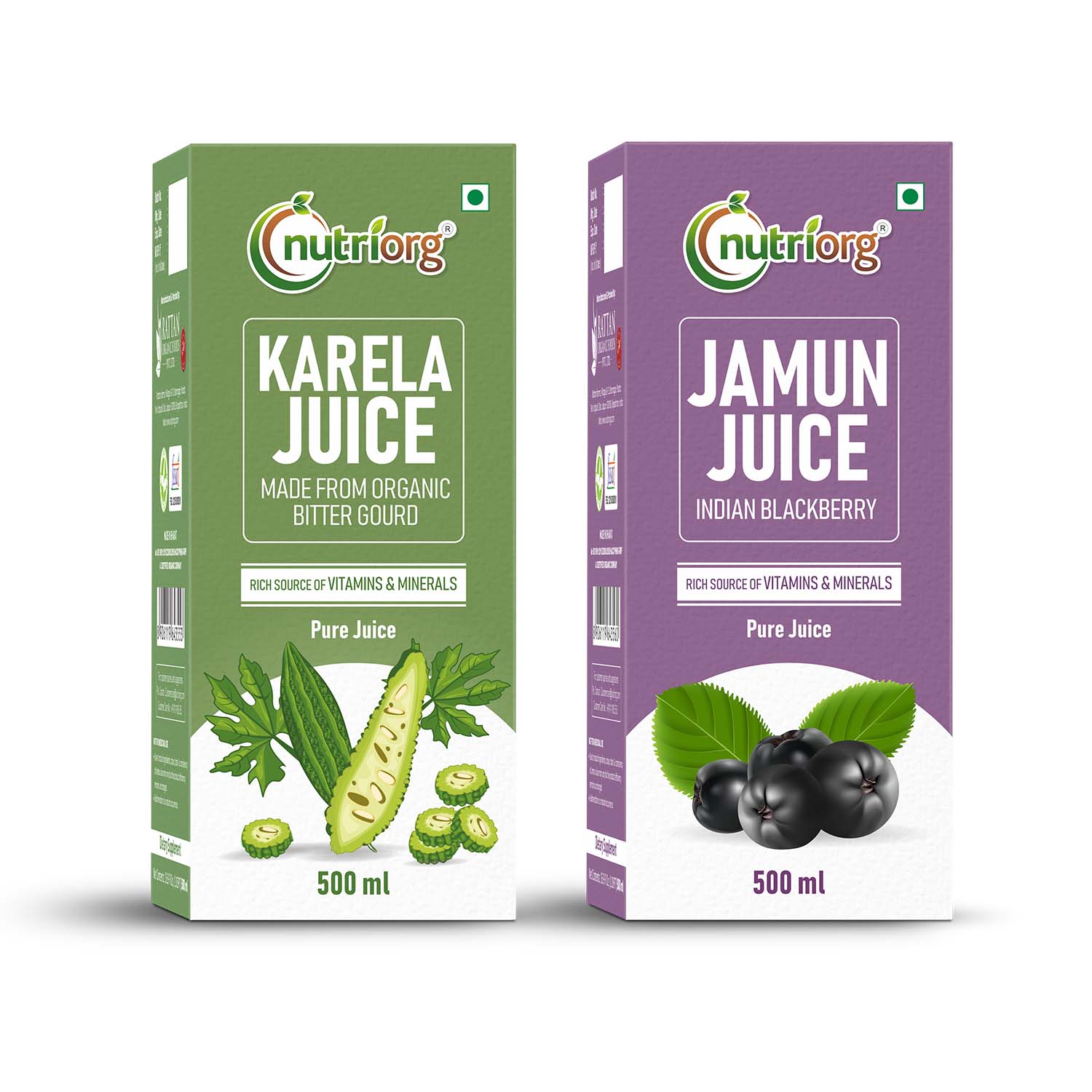
Nutriorg Karela Jamun Juice and Nutriorg Diabetic Care Juice are made with no added sugar. Use either one as a daily support along with your medicine, diet and doctor's advice. They are not a cure for diabetes.
No added sugar — a daily support for your sugar care routine. Always with your doctor's advice.
Karela jamun juice works best when you treat it with respect. Measure the dose, mix it in water, take it before a meal, and keep a close eye on your sugar. Above all, keep taking your medicine and stay in touch with your doctor. Used this way, karela jamun juice can be a safe, steady part of your daily routine.

Ghee is in every Indian kitchen. But these days you see a new name everywhere, A2 Gir Cow Ghee. It costs more than regular ghee. So people ask, is it really better? Or is it just a fancy name?
The truth is, there are real differences between A2 Gir Cow Ghee and regular ghee. The cow, the milk, and the making method are all different. And these differences matter for taste, quality and health.
At Nutriorg, we make pure A2 Gir Cow Ghee using the traditional bilona method. In this blog, we explain 6 real differences, the benefits, and how to spot pure ghee so you do not get cheated.

A2 Gir Cow Ghee is ghee made from the milk of Gir cows. Gir is a famous Indian desi cow breed from Gujarat. These cows give a special type of milk that contains A2 protein.
Most regular ghee comes from crossbred or foreign cows and buffaloes. Their milk usually has A1 protein. A2 Gir Cow Ghee comes from pure desi Gir cows whose milk has only A2 protein, which many believe is easier to digest.

The bilona method is the old, traditional way of making ghee. It is slow and takes more effort, but it gives the purest ghee.
In the bilona method, curd is made from the milk first. Then the curd is churned to get butter. Then the butter is slowly heated to make ghee. This is very different from the modern way, where ghee is made directly from cream by machines.
A2 Gir Cow Ghee made with the bilona method keeps more nutrients, better aroma and a richer taste. This is why bilona ghee is considered the gold standard.

| Point | A2 Gir Cow Ghee | Regular Ghee |
|---|---|---|
| Source | Pure desi Gir cows | Crossbred cows or buffalo |
| Protein type | A2 protein (easier to digest) | Often A1 protein |
| Making method | Traditional bilona (curd to butter to ghee) | Modern cream method by machine |
| Nutrients | Higher, method keeps goodness | Lower, mass produced |
| Taste & aroma | Rich, natural, grainy texture | Milder, often flat |
| Price | Higher (more effort, pure source) | Lower (mass produced) |
So yes, A2 Gir Cow Ghee costs more. But you are paying for a pure desi cow source, A2 protein and the slow bilona method. For many families, this is worth it.

Here are the main a2 gir cow ghee benefits that people value.

The A2 protein in Gir cow milk is believed to be gentler on the stomach. Many people who feel heavy after regular ghee find A2 ghee easier to digest.

Ghee is a good source of healthy fats. A2 Gir Cow Ghee made the bilona way keeps these fats in a natural form that may support energy and overall strength.
A2 ghee has Vitamin A, D, E and K, plus healthy fatty acids. These may support immunity, skin health and overall wellness when eaten in the right amount.
A small amount of A2 Gir Cow Ghee in dal, roti or khichdi adds taste and nutrition. It is a traditional food used across all ages in India.
Remember, ghee is healthy in the right amount. Do not eat too much. One to two teaspoons a day is enough for most people. If you have any health condition, ask your doctor.

Many brands sell normal ghee with an A2 label. Here is how to check if you are getting real A2 Gir Cow Ghee.
| Signs of Pure A2 Ghee | Signs of Fake or Low Quality |
|---|---|
| Made from desi Gir cow milk | Made from buffalo or crossbred cow milk |
| Made by the bilona method | Made by the fast cream and machine method |
| Grainy texture, rich aroma | Very smooth, flat smell |
| Melts quickly and evenly | Leaves an oily, sticky feel |
| Clear source and honest label | No clear source, only marketing words |
| Slightly higher price | Very cheap price for A2 label |
A simple home test, real ghee melts fast on your warm palm and has a natural grainy texture when set. Very cheap A2 ghee is usually not real A2 Gir Cow Ghee.
For real benefits, choose A2 Gir Cow Ghee that is made from pure desi Gir cows using the traditional bilona method. Check the source and making method, not just the label.
Nutriorg A2 Gir Cow Ghee is made from the milk of desi Gir cows using the slow bilona method. It has the rich aroma, grainy texture and A2 protein of pure desi ghee. No shortcuts. No mixing. Just pure, traditional ghee for your family.
Pure, traditional bilona ghee — made from desi Gir cows. No shortcuts, no mixing.
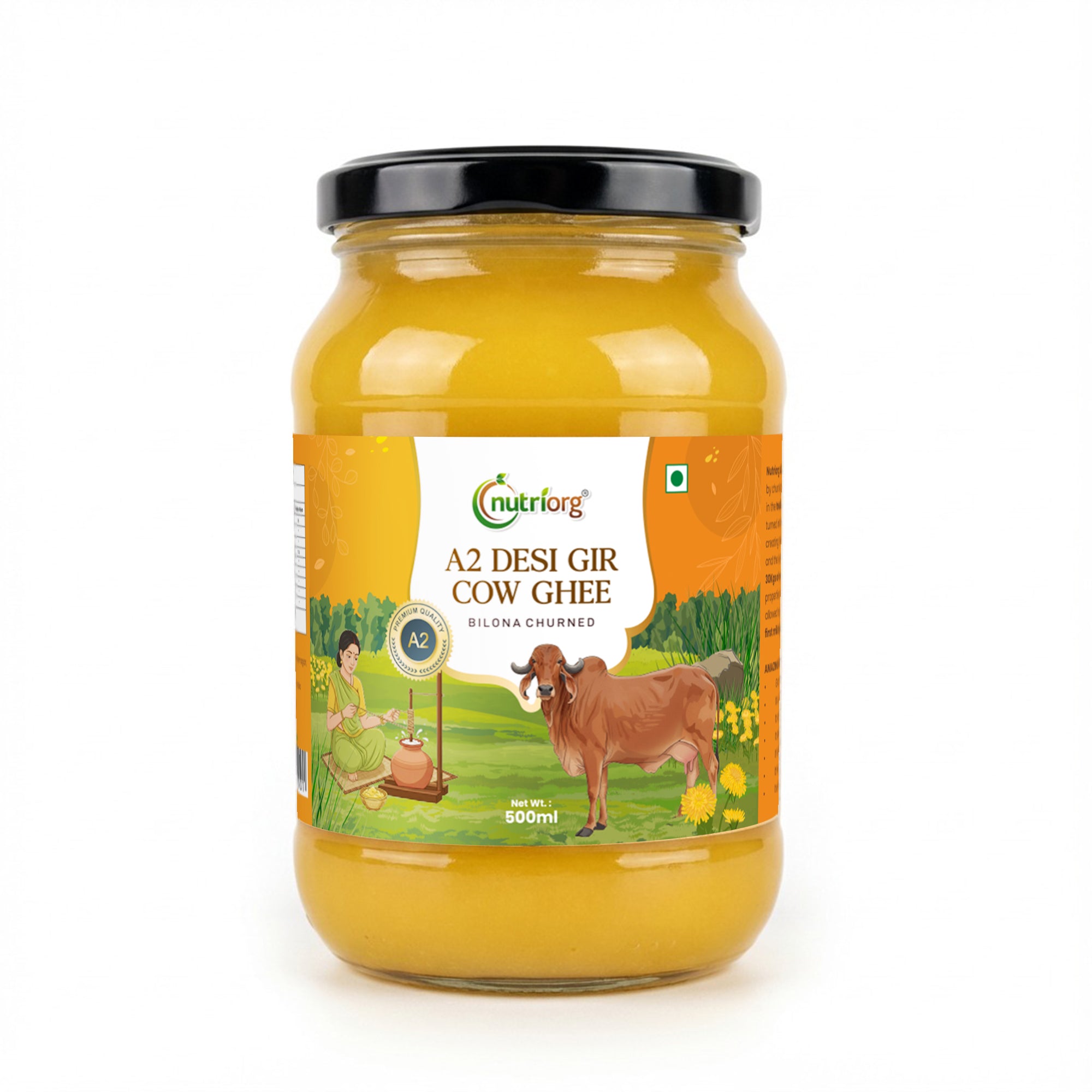
Made from desi Gir cow milk using the traditional bilona method. Rich aroma, grainy texture.
Shop NowTwo jars of pure bilona A2 ghee. Best value for your family's daily needs.
Shop Pack of 2A2 Gir Cow Ghee is not just a fancy name. The pure desi Gir cow source, the A2 protein and the slow bilona method make it different from regular ghee. It may be easier to digest and richer in taste and nutrition. Yes, it costs more, but for many families the quality is worth it. Just make sure you buy real A2 Gir Cow Ghee, made the bilona way, from a source you trust.
Your grandmother kept a bottle of it. It is thick, sticky and a little messy. But castor oil is one of the oldest and most trusted beauty oils in India. And it works.
Castor oil is used for hair growth, thicker eyebrows, dry skin and much more. It is full of a special fatty acid called ricinoleic acid, plus Vitamin E and Omega fatty acids. These nourish your hair and skin deeply.
At Nutriorg, we make cold pressed castor oil that keeps all its natural goodness. In this blog, we share 6 uses of castor oil for hair and skin and the right way to apply it so it actually works.

Castor oil is a thick oil made from castor seeds. It is different from other oils because of one special ingredient, ricinoleic acid. This fatty acid makes up almost 90 percent of castor oil.
| What Is Inside | Why It Helps |
|---|---|
| Ricinoleic acid | May nourish scalp and support hair, may soothe skin |
| Vitamin E | May protect hair and skin from damage |
| Omega 6 and 9 fatty acids | May deeply moisturise hair and skin |
| Proteins and minerals | May strengthen hair and support growth |
Always choose cold pressed castor oil for hair and skin. Cold pressing keeps all the natural nutrients. Heated or refined oil loses much of its goodness.

This is the most famous use. Castor oil for hair growth works by nourishing the scalp and hair roots. The ricinoleic acid may improve blood flow to the scalp. Better blood flow may support healthier, faster hair growth over time.

Weak roots cause hair fall. Castor oil for hair fall may help by strengthening the hair roots and reducing breakage. Regular use may mean less hair in your brush and stronger strands.

Want fuller eyebrows and lashes? Castor oil is a favourite natural remedy. Apply a tiny amount with a clean brush at night. Over weeks, it may help eyebrows and lashes look thicker and darker.

Castor oil is a deep moisturiser. The fatty acids may help lock moisture into dry, rough skin. It works well on dry patches, elbows, heels and lips. A little goes a long way.

Castor oil for face may help with dryness and dullness. Some people use it as a night oil. It may also help soften the look of fine lines over time. Always do a patch test first, as it is thick.

Castor oil mixed with a lighter oil makes a great hair mask. It may add shine, tame frizz and deeply condition dry, damaged hair. Use it once a week for smooth, healthy hair.
Castor oil is very thick and sticky. Using it the right way is important, or it becomes hard to wash off. Here is the correct method.
Do this 1 to 2 times a week. Do not apply castor oil every day. Too much can make hair greasy and heavy.
| Use | How to Apply | How Often |
|---|---|---|
| Hair growth & fall | Mix with coconut oil, massage scalp, leave 1-2 hrs | 1 to 2 times a week |
| Eyebrows & lashes | Tiny amount with clean brush at night | Every night |
| Dry skin & heels | Apply a small amount directly on dry area | Daily until better |
| Face (night oil) | 1 to 2 drops, patch test first | 2 to 3 times a week |
| Hair mask | Mix with lighter oil, apply full hair | Once a week |

| Do This | Do Not Do This |
|---|---|
| Always mix castor oil with a lighter oil | Do not apply thick castor oil alone, hard to wash |
| Do a patch test before using on face | Do not use large amounts on face |
| Use 1 to 2 times a week for hair | Do not apply on hair every single day |
| Choose cold pressed castor oil | Avoid refined or heated castor oil |
| Be patient, results take 4 to 8 weeks | Do not expect thick hair in one week |
| Warm the oil slightly before applying | Do not overheat the oil |
Castor oil is safe for most people. But if you have very oily skin or scalp, use it in small amounts. If you notice any irritation, stop and wash it off. Pregnant women should avoid taking castor oil by mouth.
For real results, you need pure, cold pressed castor oil. Refined castor oil is cheaper but has lost most of its nutrients. Cold pressed oil keeps the ricinoleic acid, Vitamin E and fatty acids that make castor oil work.
Look for castor oil that is cold pressed, hexane free and made from good quality castor seeds. It should be thick, clear and free from chemicals.
Nutriorg Cold Pressed Castor Oil is made using the cold press method. It keeps all the natural nutrients. It is pure, chemical free and great for hair growth, skin care and eyebrows. Just a small amount gives deep nourishment.
Pure, cold pressed — keeps all the natural nutrients for hair and skin.
Pure, chemical free castor oil. Keeps ricinoleic acid and Vitamin E. For hair, skin and eyebrows.
Shop NowTwo bottles of pure cold pressed castor oil. Best value for daily hair and skin care.
Shop Pack of 2Castor oil is a simple, natural and powerful oil for hair and skin. From hair growth to thicker eyebrows to soft skin, its uses are many. The secret is using it the right way, mixed with a lighter oil, a few times a week. Be patient. Give it 4 to 8 weeks. And always choose pure, cold pressed castor oil for the best results. Your grandmother was right all along.
Women do so much every day. Home, work, family, everything. But in all this, your own health often comes last. Low energy, hair fall, tiredness and weak iron levels become normal. They should not be.
Moringa can help. Moringa is called the miracle tree in India. Its leaves are packed with iron, calcium, protein and vitamins. For women, moringa is one of the most complete natural superfoods.
At Nutriorg, we make pure organic moringa powder from fresh moringa leaves. In this blog, we share 6 powerful moringa benefits for women, how to use it, and how much to take every day.

Moringa leaves are a natural multivitamin. Just one small spoon of moringa powder gives iron, calcium, protein, Vitamin A, Vitamin C and antioxidants together.
Women often lack iron and calcium. Iron loss during periods, low energy, and weak bones after 40 are common problems. Moringa gives these nutrients in a natural, easy to absorb form. This is why moringa powder for women is so useful.
| Nutrient in Moringa | How Much | Why Women Need It |
|---|---|---|
| Iron | 3 times more than spinach | May help fight anemia and tiredness |
| Calcium | Rich source | May support bones, important after 40 |
| Protein | All 9 amino acids | May support energy, hair and muscle |
| Vitamin A & C | High levels | May support skin, eyes and immunity |
| Antioxidants | Very high | May slow aging and fight damage |
| Folate | Good amount | May support women's overall health |

Anemia is very common in Indian women. Low iron causes tiredness, weakness and dizziness. Moringa has 3 times more iron than spinach. Taking moringa powder daily may help raise iron levels and fight anemia naturally.

If you feel tired all day, moringa may help. The iron, protein and B vitamins in moringa may support better energy. Many women feel more active and less weak after using moringa powder for a few weeks.

Moringa has antioxidants and nutrients that may help the body handle stress better. This may support hormonal balance. Some women find moringa helpful for mood and overall wellness during monthly changes.

The Vitamin A, Vitamin C and antioxidants in moringa may help your skin from inside. Regular use may support a natural glow and may help reduce dullness and early signs of aging. This is one of the top moringa benefits for women skin.

Hair fall troubles many women. Moringa has iron, protein and vitamins that feed the hair roots. Better nutrition may mean stronger, thicker hair. Moringa benefits for women hair make it a favourite natural remedy.

Moringa is low in calories but high in nutrients. It may help control hunger and support metabolism. Moringa benefits for women weight loss work best with a healthy diet and exercise. It is a support, not a magic powder.
Yes. After 40, women often face weak bones, low energy and skin changes. Moringa gives calcium for bones, iron for energy and antioxidants for skin. It is a simple daily support for women in their 40s, 50s and beyond.
Moringa may also support women during menopause by helping the body handle stress and stay nourished. Always talk to your doctor if you have any health condition.
Moringa powder is easy to use. Here are the best ways to take it daily.
| Way to Use | How |
|---|---|
| In warm water | Mix half to 1 teaspoon of moringa powder in warm water, drink in the morning |
| In smoothies | Add 1 teaspoon to your fruit or vegetable smoothie |
| In dal or soup | Sprinkle 1 teaspoon into cooked dal, soup or curry |
| With honey | Mix with honey and warm water for better taste |
| In buttermilk | Add to chaas or buttermilk for a healthy drink |
Start with half a teaspoon per day. After one week, increase to 1 teaspoon. Do not take more than 1 to 2 teaspoons per day. Morning is the best time, on an empty stomach or with breakfast.

| Do This | Do Not Do This |
|---|---|
| Start with half a teaspoon per day | Do not take more than 1 to 2 teaspoons per day |
| Mix in warm water, smoothie or dal | Do not take it on a very empty stomach if it upsets you |
| Be regular for at least 3 to 4 weeks | Do not expect results in 2 to 3 days |
| Choose pure, organic moringa powder | Avoid powder with fillers or artificial colour |
| Talk to your doctor if pregnant | Do not take large amounts during pregnancy without advice |
| Eat a balanced diet along with moringa | Do not depend on moringa alone for nutrition |
Moringa is safe for most women. But if you are pregnant, breastfeeding or on any medicine, please talk to your doctor before starting. Pregnant women should avoid large amounts of moringa.

For real benefits, you need pure, organic moringa powder. Many brands mix fillers or use old leaves. This reduces the nutrition.
Look for moringa powder that is bright green, organic and made from fresh leaves. It should have no fillers, no added colour and no artificial ingredients. A dull, brownish powder usually means low quality.
Nutriorg Organic Moringa Powder is made from fresh, organic moringa leaves. It is 100% pure. No fillers. Nothing artificial. Just clean, green moringa full of iron, calcium and vitamins for women's daily wellness.
Pure, organic moringa powder — 100% natural, no fillers, nothing artificial.
Pure, organic moringa powder from fresh leaves. Rich in iron, calcium and protein. No fillers.
Shop NowTwo packs of pure organic moringa powder. Best value for daily wellness.
Shop Pack of 2Moringa is a simple, powerful superfood made for a woman's busy life. From energy to iron to skin to hair, the moringa benefits for women cover so many needs in one green spoon. Start with a small amount every morning. Be patient. Stay regular. And choose pure, organic moringa powder for the best results. Your body does so much for you. Give it the nourishment it deserves.